Research Category

Flow Diagnostics and Event-Based Sensing

This research focuses on new ways to measure and reconstruct complex flow fields, especially when the flow is highly unsteady or difficult to capture with conventional tools. The work spans event-based cameras, optical diagnostics, embedded sensing, and algorithm development aimed at improving temporal resolution, spatial fidelity, and measurement robustness. Together, these studies advance both the instrumentation and the analysis methods needed for modern experimental fluid mechanics.

Infographic

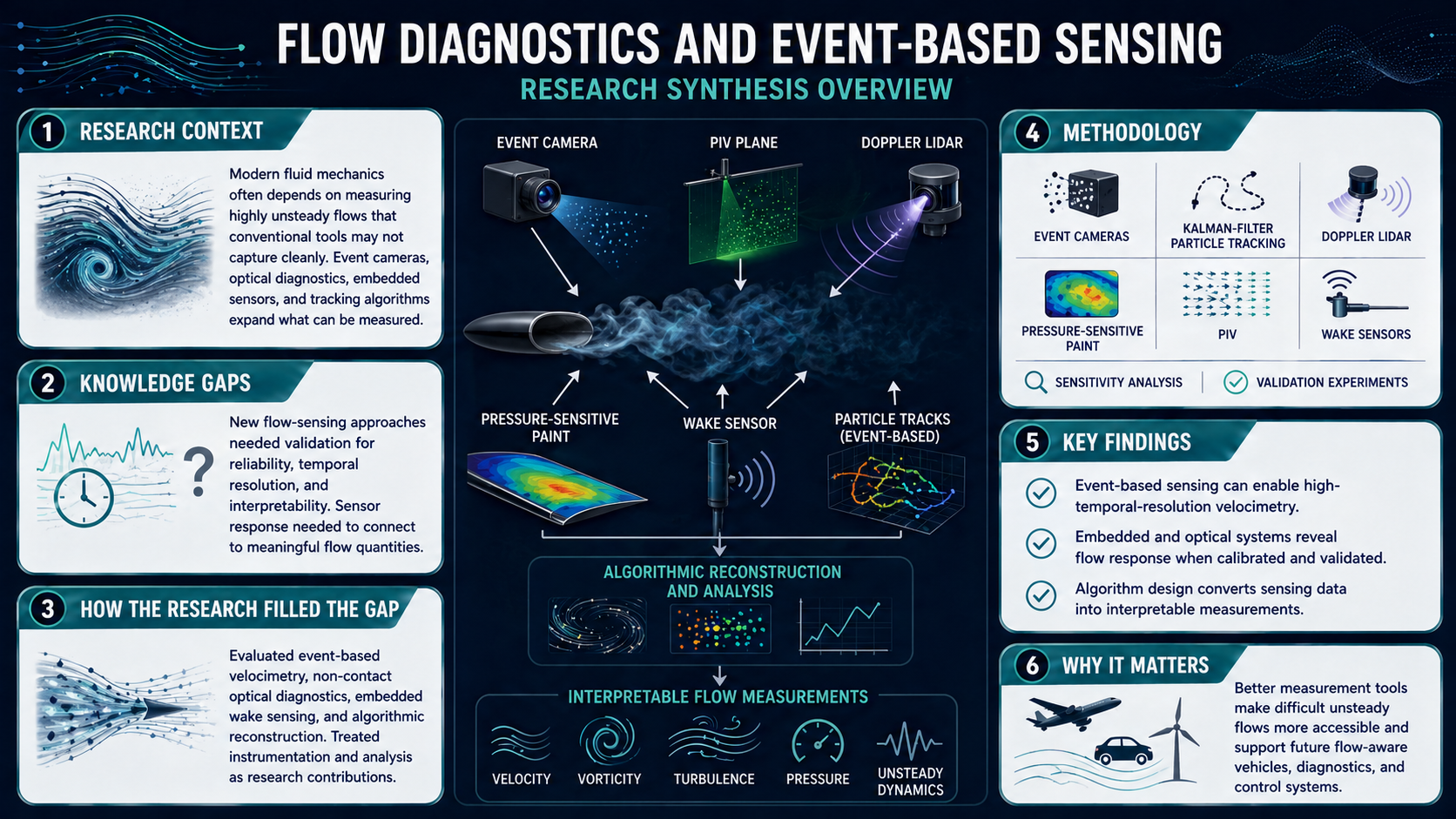
Research category infographic

Generated infographic for this full research category. Click the image to open the full-size PNG.

Category Infographic infographic

Category Infographic

Research Directions

Focused lines of work within this area

Each subcategory offers a more focused view of the questions, methods, and applications that shape this broader research area.

Embedded Wake Sensing and Flow-Response Testbeds

Research in this area explores sensing strategies in which the measurement device is itself a flexible flow-responsive structure. The core studies use piezo-embedded inverted PVDF flags placed in the wake of airfoils to quantify how voltage response, oscillation frequency, and structural motion vary with angle of attack, downstream position, and wake unsteadiness. Instead of treating sensing as a purely external imaging task, the work asks how a lightweight embedded element can become part of the aerodynamic system and still return physically meaningful information about the surrounding flow. The result is a compact approach to wake detection that connects materials, fluid response, and instrumentation.

2 papers
Open Subcategory

Event-Camera Velocimetry and Algorithm Development

Research in this area develops event-based cameras into serious tools for experimental fluid mechanics rather than treating them as a novelty in machine vision. Unlike conventional imaging systems that record full frames at fixed time intervals, event cameras register changes in intensity asynchronously, making them especially attractive for flows with fast transients, sparse motion cues, or strong local gradients. The work spans particle event velocimetry, weighted tracking, Kalman-filter-based tracking, motion-compensation methods, simulator-based benchmarking, and sensitivity analysis across wing, wake, and cavity flows. Taken together, the studies show how event-driven sensing can recover meaningful velocity fields while preserving the experimental simplicity that makes planar diagnostics practical in the laboratory.

6 papers
Open Subcategory

Non-Contact Optical Diagnostics

This work advances optical measurement techniques for situations where conventional probes are too intrusive and standard imaging methods do not provide the needed access. The research includes Doppler lidar for velocity measurement in wind-tunnel flows and back-imaged pressure-sensitive paint for resolving the surface-pressure footprint of propellers operating near the ground. Both approaches are built around the same experimental priority: obtaining useful flow information while disturbing the flow as little as possible. The result is a diagnostic capability that reaches difficult geometries and boundary conditions without sacrificing physical relevance.

2 papers
Open Subcategory
Contributors

Students who contributed to this work

Students connected to the publications and projects represented on this page.

Publications

Research publications in this area

Publication entries include citation details and student contributors where available.

Aerospace 06 00033

Students

Student contributors are listed where available.

Citation
  • Aerospace 06 00033. 2019.

Event-Based Velocimetry in Additive-Manufacturing Flowfields

Students

Student contributors are listed where available.

Citation
  • Event-Based Velocimetry in Additive-Manufacturing Flowfields. 2026.

Toward Event-Based Noise-Robust High Density Particle Velocimetry

Students
Citation
  • AlSattam, Osama A., Michael P. Mongin, Andrew Killian, Sidaard Gunasekaran, and Keigo Hirakawa. "Toward Event-Based Noise-Robust High Density Particle Velocimetry." In AIAA SCITECH 2024 Forum, p. 2663. 2024. https://doi.org/10.2514/6.2024-2663

Comparison of Event-Based Alogrithms for Experimental Two-Dimensional, Two-Component Velocimetry

Students
Citation
  • Gunasekaran, Sidaard, Michael Mongin, Osama A. AlSattam, and Keigo Hirakawa. "Comparison of Event-Based Alogrithms for Experimental Two-Dimensional, Two-Component Velocimetry." Journal of Aircraft (2025): 1-15. https://doi.org/10.2514/1.C038412

Comparison of Event Camera Processing Algorithms for Experimental 2D2C Velocimetry

Students
Citation
  • Gunasekaran, Sidaard, Michael Mongin, Osama A. AlSattam, and Keigo Hirakawa. "Comparison of Event Camera Processing Algorithms for Experimental 2D2C Velocimetry." In AIAA SCITECH 2025 Forum, p. 0475. 2025. https://doi.org/10.2514/6.2025-0475

Sensitivity Analysis of Event Based Algorithms for Velocimetry

Students
Citation
  • Khan, Abdul R., and Sidaard Gunasekaran. "Sensitivity Analysis of Event Based Algorithms for Velocimetry." In AIAA SCITECH 2026 Forum, p. 1316. 2026. https://doi.org/10.2514/6.2026-1316

Causal Kalman Filtering for Particle Tracking Velocimetry Using an Event Camera

Students
Citation
  • Khan, Abdul R., Michael P. Mongin, Andrew Killian, Keigo Hirakawa, and Sidaard Gunasekaran. "Causal Kalman Filtering for Particle Tracking Velocimetry Using an Event Camera." Experiments in Fluids (2024).

Investigation of Doppler Lidar for Velocity Measurements in Wind Tunnels

Students
Citation
  • Barnhart, Samuel A., and Sidaard Gunasekaran. "Investigation of Doppler Lidar for Velocity Measurements in Wind Tunnels." In AIAA Scitech 2020 Forum, p. 1021. 2020. https://doi.org/10.2514/6.2020-1021

Back-Imaging of Pressure-Sensitive Paint to Determine Close Proximity Ground Effects of Propellers

Students
Citation
  • Kulig, Jacob, Jielong Cai, Sidaard Gunasekaran, and Carson L. Running. "Back-Imaging of Pressure-Sensitive Paint to Determine Close Proximity Ground Effects of Propellers." In AIAA SCITECH 2024 Forum, p. 0878. 2024. https://doi.org/10.2514/6.2024-0878