Research Category

Wing Aerodynamics and Wake Physics

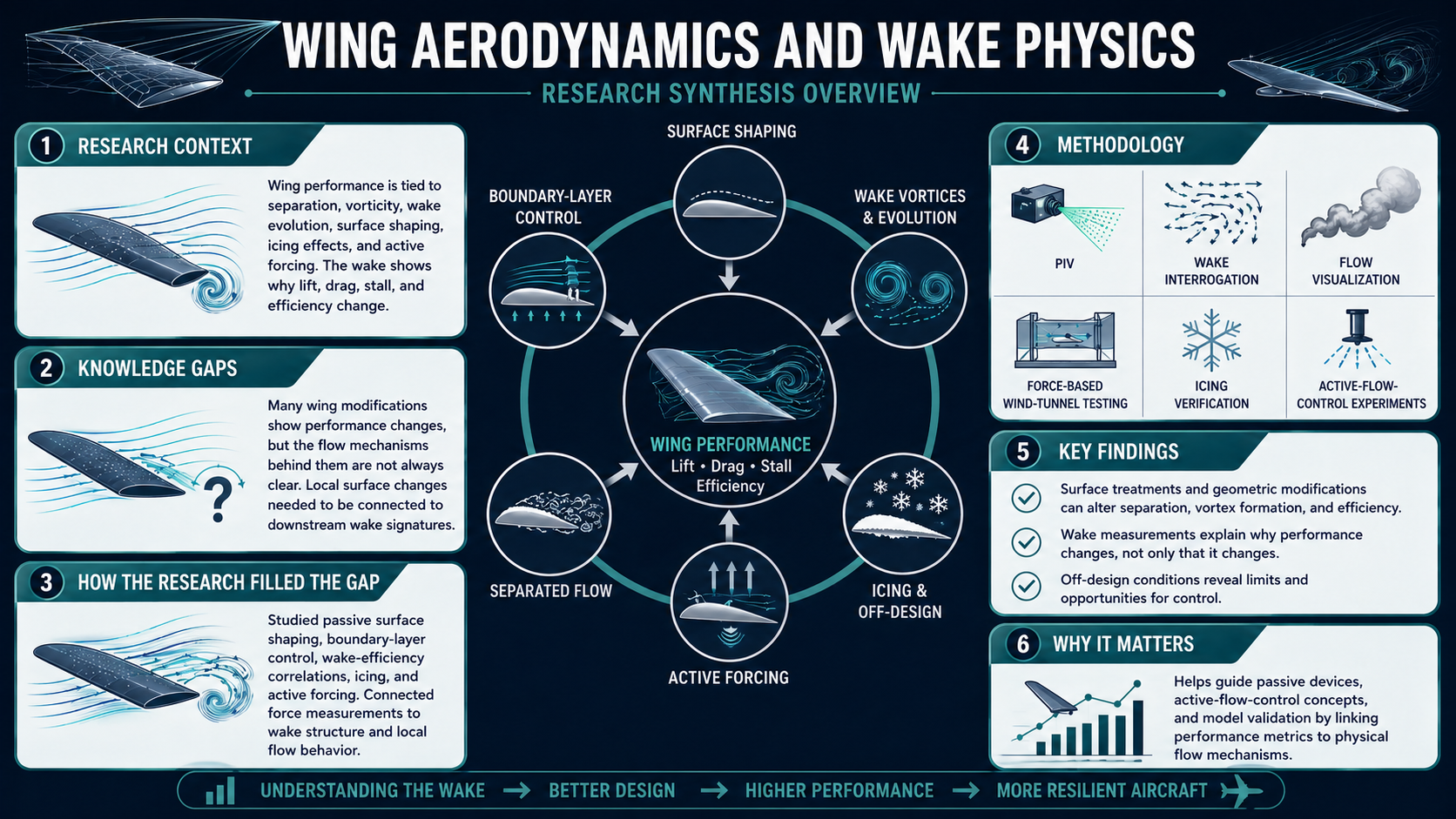
This research examines how wings generate, reshape, and shed vorticity under a wide range of passive and active modifications. Geometry changes, surface treatments, icing, blowing, and boundary-layer control are used to connect local flow physics to lift, drag, stall behavior, and aerodynamic efficiency. Across the category, wake structure is treated as a key window into aerodynamic performance rather than just a downstream consequence.

Infographic

Research category infographic

Generated infographic for this full research category. Click the image to open the full-size PNG.

Category Infographic infographic

Category Infographic

Research Directions

Focused lines of work within this area

Each subcategory offers a more focused view of the questions, methods, and applications that shape this broader research area.

Off-Design, Iced, and Actively Forced Wings

This research examines wing behavior in conditions where baseline aerodynamic assumptions no longer hold. The work spans ice-accreted airfoils, actively blown wings, and dynamically pitching delta wings with leading-edge-vortex control, all of which push the flow into regimes shaped by separation, contamination, actuation, or rapid motion. Rather than treating these cases as minor perturbations of a clean wing, the studies show that off-design conditions reorganize the flow in fundamental ways, changing coherent structures, wake development, vortex stability, and the relationship between geometry and performance.

3 papers
Open Subcategory

Passive Surface Shaping and Boundary-Layer Control

This research explores how carefully chosen passive geometric changes can reshape the surface flow and wake of a wing without relying on powered actuation. The work spans segmented trailing-edge extensions, chordwise slots, curved boundary-layer fences, surface contours, and airfoil-preserved undulations, all aimed at altering how vorticity forms, convects, and organizes itself around the wing. Taken together, the studies show that passive modifications can influence both parasite drag and induced drag by changing separation behavior, spanwise flow feeding into the wingtip vortex, and the structure of the downstream wake.

8 papers
Open Subcategory

Wake Structure and Efficiency Correlations

This research investigates aerodynamic efficiency through the wake rather than through force coefficients alone. Using time-resolved and planar particle image velocimetry, the work examines how momentum deficit, vorticity, turbulent fluctuations, Reynolds stresses, and shear-layer organization evolve behind wings and airfoils as operating condition changes. A consistent result across near-wake and far-wake studies is that efficient operating states leave a distinct flow signature: around maximum aerodynamic efficiency, the wake becomes quieter, more ordered, and less turbulent than it is on either side of that condition.

4 papers
Open Subcategory
Contributors

Students who contributed to this work

Students connected to the publications and projects represented on this page.

Rachael Supina
Contributor

Rachael Supina

Publications

Research publications in this area

Publication entries include citation details and student contributors where available.

Blown Wing Aerodynamic Coefficient Predictions Using Traditional Machine Learning And Data Science

Students

Student contributors are listed where available.

Citation
  • Blown Wing Aerodynamic Coefficient Predictions Using Traditional Machine Learning And Data Science. 2021.

Low Reynolds Number Experimental Aerodynamic Verification Of Scaled And Lewice Simulated Ice

Students

Student contributors are listed where available.

Citation
  • Low Reynolds Number Experimental Aerodynamic Verification Of Scaled And Lewice Simulated Ice. 2022.

Experimental Investigation of Dynamic Pitching Effects on a Delta Wing with Blown Jet

Students
Citation
  • Pabon, Julian A., and Sidaard Gunasekaran. "Experimental Investigation of Dynamic Pitching Effects on a Delta Wing with Blown Jet." In AIAA SCITECH 2026 Forum, p. 0285. 2026. https://doi.org/10.2514/6.2026-0285

Aerospace 05 00089

Students

Student contributors are listed where available.

Citation
  • Aerospace 05 00089. 2018.

Effect Of Segmented Trailing Edge Extensions In Aerodynamic Efficiency

Students

Student contributors are listed where available.

Citation
  • Effect Of Segmented Trailing Edge Extensions In Aerodynamic Efficiency. 2018.

Effect Of Chordwise Slots On Aerodynamic Efficiency

Students

Student contributors are listed where available.

Citation
  • Effect Of Chordwise Slots On Aerodynamic Efficiency. 2018.

Affecting Aerodynamic Efficiency by Influencing Wing Surface- Flow Direction

Students
Citation
  • Gunasekaran, Sidaard and Nathan Thomas. "Affecting Aerodynamic Efficiency by Influencing Wing Surface- Flow Direction." 2018 AIAA Aerospace Sciences Meeting, AIAA 2018-0344. https://doi.org/10.2514/6.2018-0344

Effect of Airfoil- Preserved Undulations on Wing Performance

Students
Citation
  • Loughnane, Faith A., Rachael Supina, Michael P. Mongin, and Sidaard Gunasekaran. "Effect of Airfoil- Preserved Undulations on Wing Performance." In AIAA Scitech 2020 Forum, p. 1784. 2020. https://doi.org/10.2514/6.2020-1784

Effect Of Curved Boundary Layer Fences On Aerodynamic Efficiency

Students

Student contributors are listed where available.

Citation
  • Effect Of Curved Boundary Layer Fences On Aerodynamic Efficiency. 2019.

Preprints201807.0028.V1

Students

Student contributors are listed where available.

Citation
  • Preprints201807.0028.V1. 2018.

Energies 14 03641 V2

Students

Student contributors are listed where available.

Citation
  • Energies 14 03641 V2. 2021.

On the Near Wake Turbulent Flow Properties of the SD7003 Airfoil

Students
Citation
  • Goodman, Steven, Sidaard Gunasekaran, Aaron Altman, and Albert Medina. "On the Near Wake Turbulent Flow Properties of the SD7003 Airfoil." In AIAA Scitech 2019 Forum, p. 0073. 2019. https://doi.org/10.2514/6.2019-0073

Better Insight Into The Wingtip Vortex Free Shear Layer Interaction

Students

Student contributors are listed where available.

Citation
  • Better Insight Into The Wingtip Vortex Free Shear Layer Interaction. 2017.

Airfoil Near Wake Turbulent Properties at Maximum Aerodynamic Efficiency Condition

Students
Citation
  • Gunasekaran, Sidaard, and Rachel Sharp. "Airfoil Near Wake Turbulent Properties at Maximum Aerodynamic Efficiency Condition." In AIAA Scitech 2021 Forum, p. 1848. 2021. https://doi.org/10.2514/6.2021-1848