Wake Characteristics of Bell-Shaped Lift Distribution
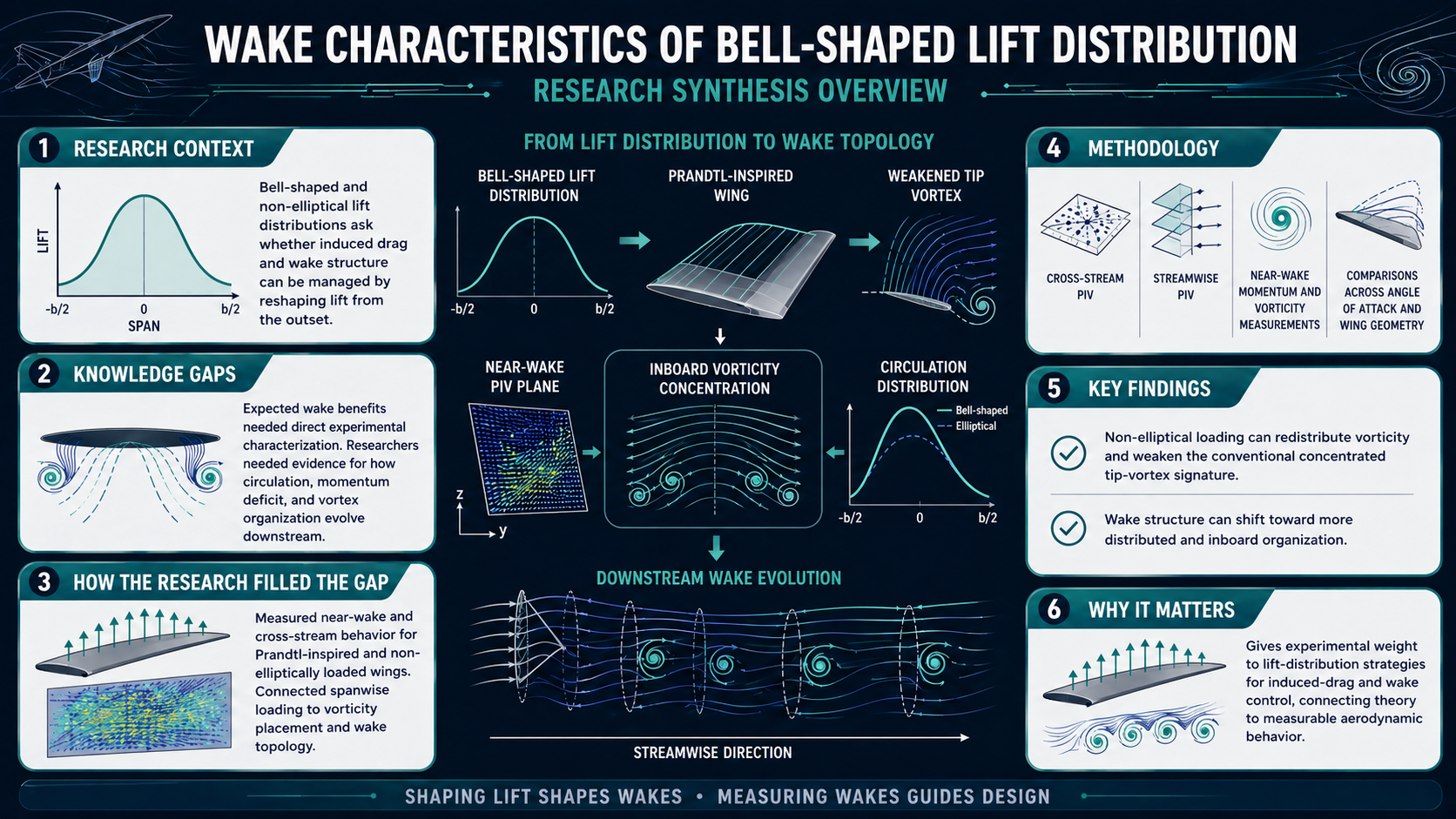
This research focuses on how spanwise lift distribution changes the structure of the wake, especially near the wingtip. The papers examine bell-shaped and other non-elliptical loading strategies and show how load shaping can redistribute circulation, weaken conventional tip vortices, and alter the evolution of the near wake. Together, they provide an experimental view of wake control as a pathway toward lower induced drag and more efficient lifting-surface design.
Infographic
Research category infographic
Generated infographic for this full research category. Click the image to open the full-size PNG.
Category Infographic
Research Directions
Focused lines of work within this area
Each subcategory offers a more focused view of the questions, methods, and applications that shape this broader research area.
This research explores how the wake changes when spanwise lift distribution moves away from the classical elliptical form toward bell-shaped and other non-elliptical loadings. The studies compare multiple wing configurations and show that changing the way circulation tapers near the tip can reshape the wake in fundamental ways, including weaker downwash concentration, delayed roll-up, and vorticity structures that remain flatter and more inboard than those associated with a conventional tip vortex. The emphasis is on the wake as a dynamic expression of loading choice, not merely as a downstream byproduct.
Research in this area investigates the near wake of Prandtl-D3 and D3C wing concepts to understand whether bell-shaped loading can fundamentally alter the familiar structure of trailing-vortex formation. Using force measurements, streamwise and cross-stream particle image velocimetry, and comparisons with aerodynamic simulations, the work studies how these wings shed momentum and vorticity near the tip and farther inboard. A consistent picture emerges in which the wake near the design condition is not organized around the conventional, concentrated wingtip vortex, but around a more distributed and inboard-shifted vorticity structure.
Cain, Charles B., and Sidaard Gunasekaran. "Wake Characteristics of a Bell-Shaped Lift Distribution." In AIAA SciTech 2026 Forum, p. 2327. 2026. https://doi.org/10.2514/6.2026-2327
Variations in the Wake Structure of Non-Elliptical Lift Distributions Near Wingtip
Schreyer, Grace A., Sidaard Gunasekaran, Julian A. Pabon, and Jielong Cai. "Variations in the Wake Structure of Non-Elliptical Lift Distributions Near Wingtip." In AIAA SCITECH 2025 Forum, p. 0253. 2025. https://doi.org/10.2514/6.2025-0253
Cross-Stream PIV Characterization of the Prandtl-D3C Wake
Cain, Charles B., Jessica C. DeMoor, and Sidaard Gunasekaran. "Cross-Stream PIV Characterization of the Prandtl-D3C Wake." In AIAA SCITECH 2026 Forum, p. 2328. 2026. https://doi.org/10.2514/6.2026-2328
Experimental Investigation of Prandtl-D3 Near Wake Signature
Pabon, Julian A., Grace Schreyer, Sidaard Gunasekaran, Michael Mongin, Aaron Altman, and Patrick Hammer. "Experimental Investigation of Prandtl-D3 Near Wake Signature." In AIAA SCITECH 2025 Forum, p. 2758. 2025. https://doi.org/10.2514/6.2025-2758