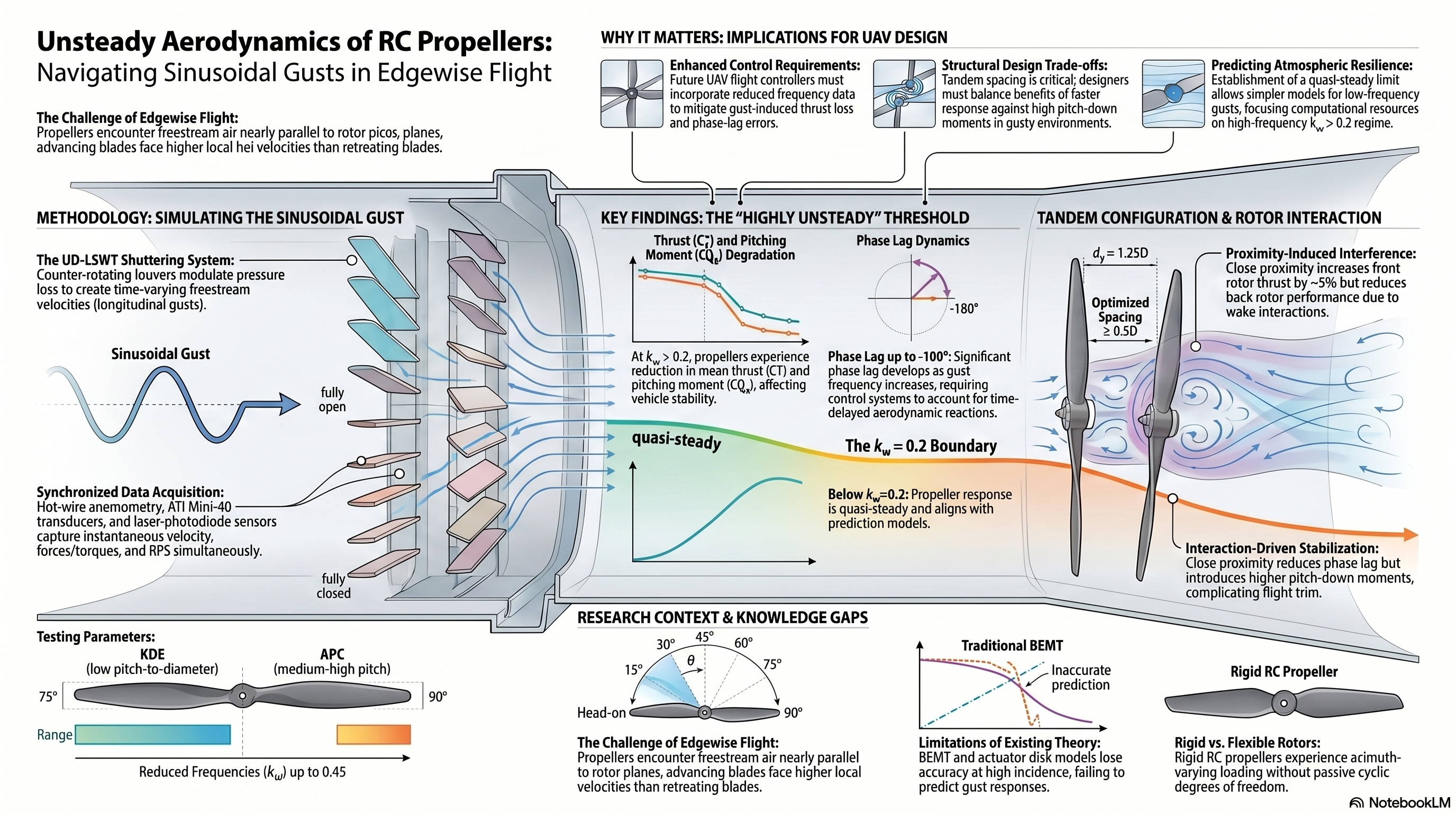
Research in this area examines how propellers respond when the incoming flow is no longer steady, especially in the forward-flight and edgewise-flight conditions that are increasingly relevant to UAVs, air taxis, and other distributed-propulsion systems. The work studies sinusoidal streamwise gusts, changes in rotor incidence angle, and tandem propeller arrangements to understand how thrust, power, and pitching response evolve when a propeller must operate inside a time-varying aerodynamic environment rather than a fixed one. A central result is that propeller gust response is shaped not only by the disturbance itself, but also by rotor orientation and by wake interaction between neighboring propellers.
Infographic
Research infographic
NotebookLM-generated infographic and video assets for this research subcategory. Click any image to open the full-size file, or play videos directly on the page.
Propeller Gust ResponseRC Propeller Unsteady Aerodynamics Study
Contributors
Students who contributed to this work
Students connected to the publications and projects represented on this page.
Cai, Jielong, Sidaard Gunasekaran, and Michael V. Ol. "Sinusoidal Gust Response of RC Propellers at Different Incidence Angles." In AIAA SCITECH 2022 Forum, p. 1536. 2022. https://doi.org/10.2514/6.2022-1536