
Infographic
Research infographic
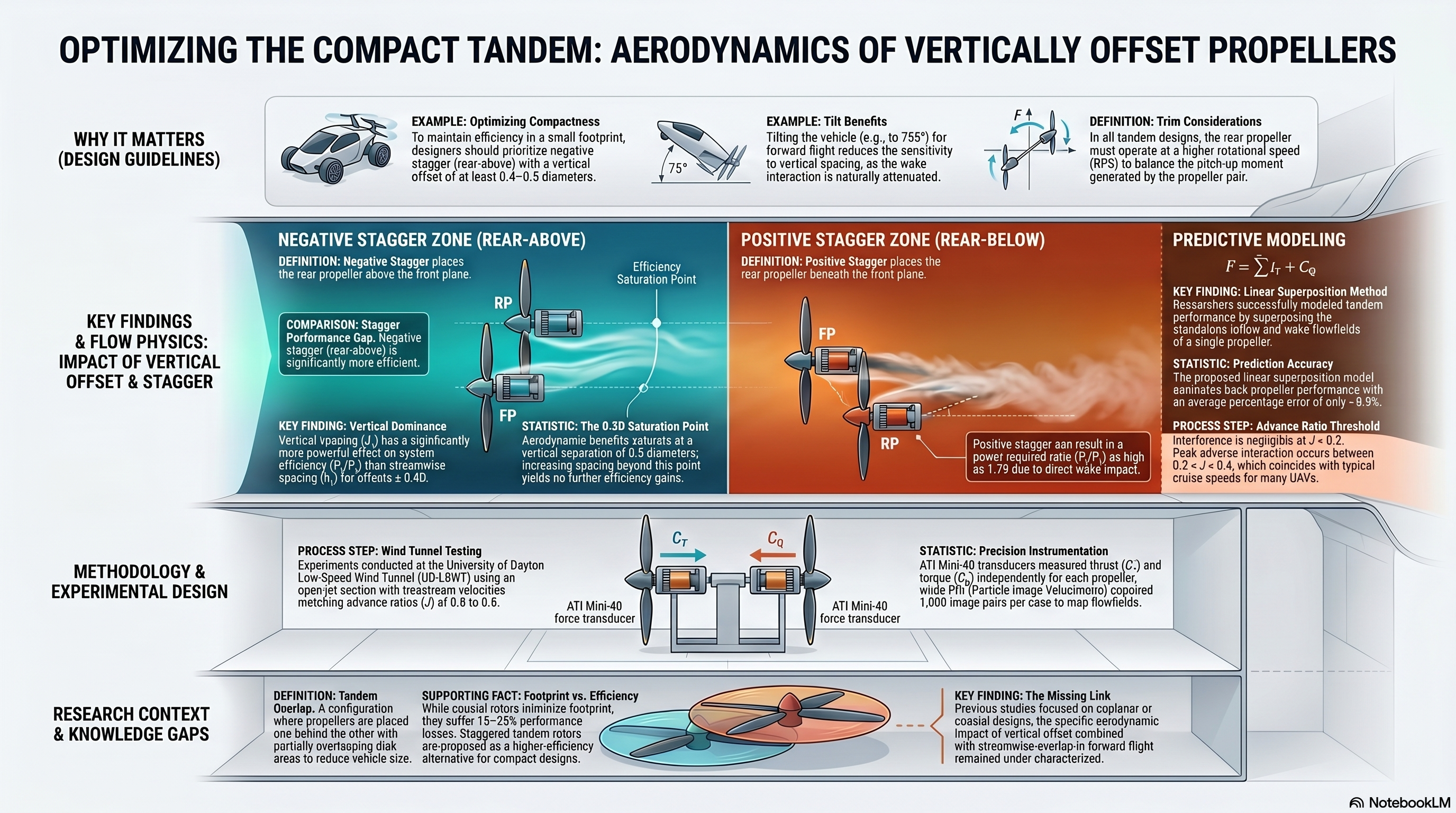
NotebookLM-generated infographic and video assets for this research subcategory. Click any image to open the full-size file, or play videos directly on the page.
Contributors
Students who contributed to this work
Students connected to the publications and projects represented on this page.
Publications
Research publications in this area
Publication entries include citation details and student contributors where available.
Vertically Offset Overlapping Propellers in Tandem Configuration
- Cai, Jielong, Sidaard Gunasekaran, and Michael V. Ol. "Vertically Offset Overlapping Propellers in Tandem Configuration." In AIAA SCITECH 2023 Forum, p. 2464. 2023. https://doi.org/10.2514/6.2023-717042464
Investigation of Positively Staggered Vertically Offset Propellers in Tandem
- Cai, Jielong, Sidaard Gunasekaran, and Michael Ol. "Investigation of Positively Staggered Vertically Offset Propellers in Tandem." In AIAA SCITECH 2024 Forum, p. 1510. 2024. https://doi.org/10.2514/6.2024-1510
Prediction of the Tandem Propeller Performance Using Linear Superposition Method
- Cai, Jielong, and Sidaard Gunasekaran. "Prediction of the Tandem Propeller Performance Using Linear Superposition Method." In AIAA SCITECH 2025 Forum, p. 1268. 2025. https://doi.org/10.2514/6.2025-1268