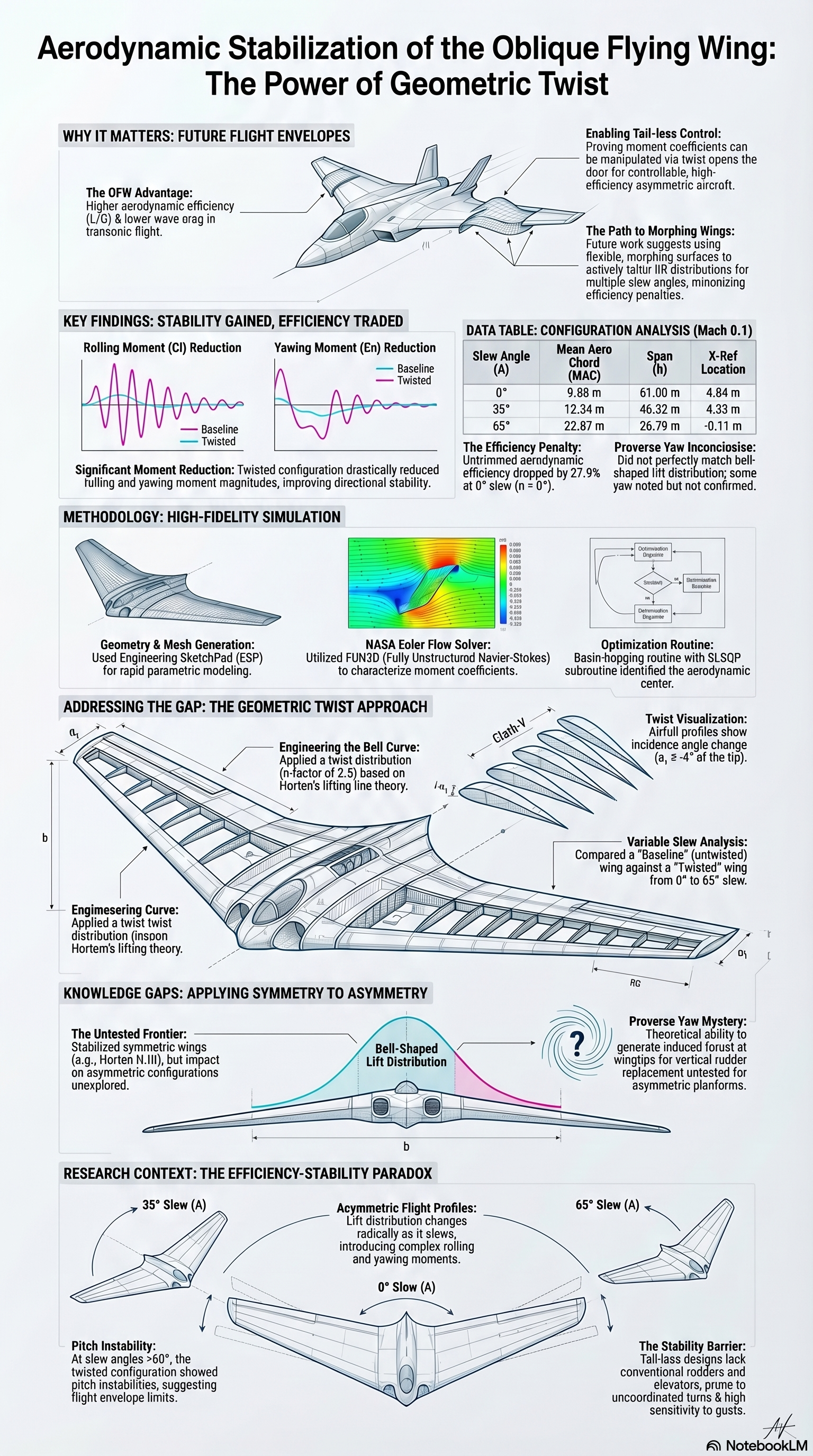
This work explores spanwise loading as a primary aerodynamic design variable, using an oblique flying wing to study how twist distribution and slew angle reshape performance and stability. Instead of starting from the assumption that a wing’s planform alone determines its behavior, the research examines how deliberately redistributing lift along the span can change rolling, pitching, and yawing tendencies as well as the character of the wake. The result is a more design-centered view of spanloading, where aerodynamic efficiency and stability are treated as consequences of how lift is arranged across the wing rather than how much lift is produced overall.
Infographic
Research infographic
NotebookLM-generated infographic and video assets for this research subcategory. Click any image to open the full-size file, or play videos directly on the page.
Power of Geometric Wing Twist
Contributors
Students who contributed to this work
Students connected to the publications and projects represented on this page.
Student contributors will appear here as publication and profile information becomes available.
Publications
Research publications in this area
Publication entries include citation details and student contributors where available.
Effects Of Spanloading And Slew Angle On An Oblique Flying Wing
Students
Student contributors are listed where available.
Citation
Effects Of Spanloading And Slew Angle On An Oblique Flying Wing. 2020.