Research Category

Experimental Platforms and Cross-Domain Fluid Systems

This research highlights the experimental platforms, teaching tools, and cross-domain applications that support and extend fluid-dynamics work. The papers span wind-tunnel development, additive-manufactured facilities, wind-energy studies, and pedagogical models for aerodynamics education. Together, they show that research capability is built not only through technical results, but also through the facilities, methods, and educational infrastructure that make those results possible.

Infographic

Research category infographic

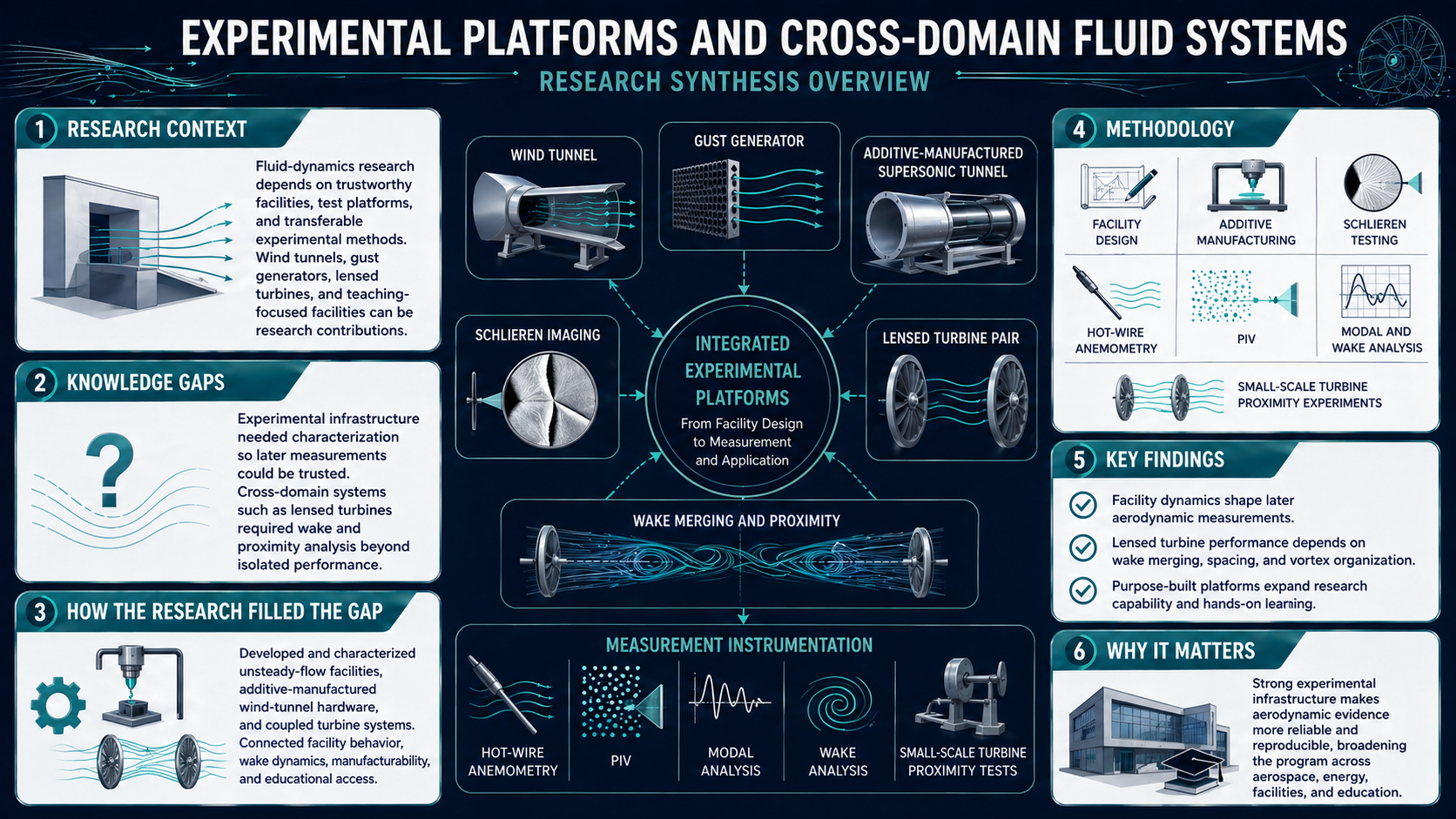
Generated infographic for this full research category. Click the image to open the full-size PNG.

Category Infographic infographic

Category Infographic

Research Directions

Focused lines of work within this area

Each subcategory offers a more focused view of the questions, methods, and applications that shape this broader research area.

Experimental Facilities and Instrumentation

This research treats the experimental platform itself as a scientific contribution. Rather than viewing tunnels, flow generators, and test hardware as background infrastructure, the work studies how facility design, actuation strategy, optical access, manufacturability, and dynamic response shape the quality of the aerodynamic knowledge that follows. The projects include a shuttered open-jet wind tunnel for unsteady-flow generation and an additive-manufactured supersonic wind tunnel designed for both education and research. Together, they show that meaningful advances in fluid mechanics often begin with building better environments in which to ask the question.

2 papers
Open Subcategory

Lensed Turbines

This research examines how wind-lens geometries modify turbine performance and how neighboring lenses interact aerodynamically when placed in close proximity. The work combines design, small-scale performance testing, wake measurements, and array-level thinking to understand how ducted or flanged turbine concepts behave as aerodynamic systems rather than isolated devices. Wake skew, vortex interaction, spacing effects, and proximity-dependent power changes all play a central role. The studies show that the value of a lensed turbine is not only in local augmentation, but in how the lens shapes the wake environment seen by nearby devices.

3 papers
Open Subcategory
Contributors

Students who contributed to this work

Students connected to the publications and projects represented on this page.

Thomas Cook
Contributor

Thomas Cook

Publications

Research publications in this area

Publication entries include citation details and student contributors where available.

Frequency Response of a Shuttered Open Jet Wind Tunnel

Students
Michael MonginThomas Cook
Citation
  • Cook, Thomas, Sidaard Gunasekaran, Michael V. Ol, and Michael P. Mongin. "Frequency Response of a Shuttered Open Jet Wind Tunnel." In AIAA Scitech 2020 Forum, p. 1760. 2020. https://doi.org/10.2514/6.2020-1760

Design and Analysis of an Additive Manufactured Supersonic Wind Tunnel

Students
Citation
  • Gazella, Matthew R., Jonathon Hill, Scott Chriss, Austin J. Abel, and Sidaard Gunasekaran. "Design and Analysis of an Additive Manufactured Supersonic Wind Tunnel." In AIAA Scitech 2020 Forum, p. 1354. 2020. https://doi.org/10.2514/6.2020-1354

Energies 15 04622

Students

Student contributors are listed where available.

Citation
  • Energies 15 04622. 2022.

Performance and Proximity Investigations on Small Scale Lensed Turbines

Students
Citation
  • Novotny, Neal, and Sidaard Gunasekaran. "Performance and Proximity Investigations on Small Scale Lensed Turbines." In AIAA Scitech 2020 Forum, p. 1242. 2020. https://doi.org/10.2514/6.2020-1242

Investigation into Wake Interactions of Wind Lenses at Close Proximities

Students
Citation
  • Peyton, Madison N., and Sidaard Gunasekaran. "Investigation into Wake Interactions of Wind Lenses at Close Proximities." In AIAA SCITECH 2022 Forum, p. 1789. 2022. https://doi.org/10.2514/6.2022-1789